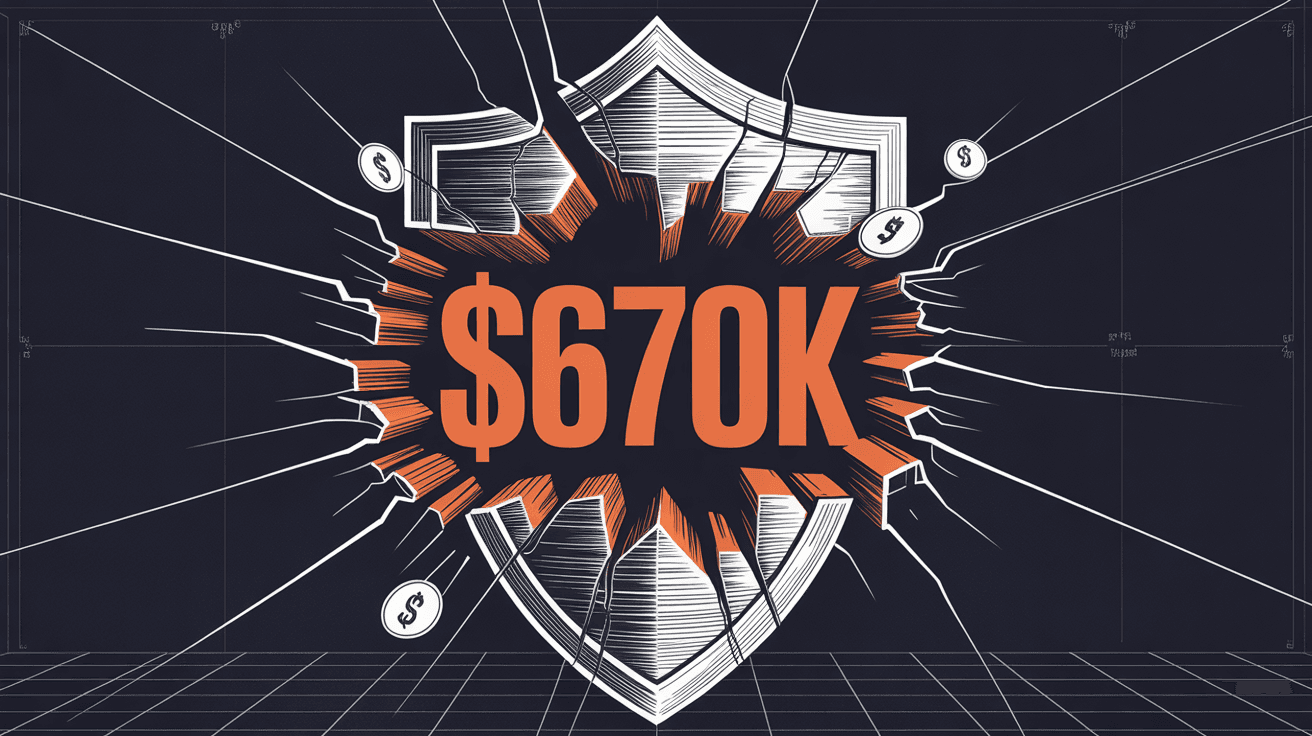
When IBM released their 2025 Cost of Data Breach Report, one number caught every security professional's attention: $670,000.
That's how much more organizations pay when shadow AI is involved in a data breach. Not the total cost—the additional cost on top of an already devastating average breach price of $4.44 million.
Let's break down what's really happening here and what it means for your organization.
The Numbers That Matter
IBM's research analyzed thousands of breaches across industries and geographies. Here's what they found about AI and security:
| Finding | Statistic | Implication |
|---|---|---|
| Global average breach cost | $4.44M | Baseline we're all trying to avoid |
| Shadow AI breach premium | +$670K | Additional cost when unauthorized AI is involved |
| Organizations lacking AI access controls | 97% | Almost everyone breached had this gap |
| Cost savings with AI security tools | $1.9M | Organizations using AI for defense save money |
The contrast is stark: organizations using AI strategically for security save nearly $2 million per breach. Organizations with uncontrolled AI usage pay an extra $670K. The difference between those two positions is $2.57 million—per incident.
Why Shadow AI Breaches Cost More
The $670K premium isn't arbitrary. It reflects real, measurable factors that compound breach costs:
Extended Detection Time
Shadow AI tools create data flows that security teams don't monitor. When data is exfiltrated through an AI service, it doesn't trigger the same alerts as traditional channels. This extends the critical "dwell time"—how long attackers remain undetected in your environment.
The average breach already takes 241 days to identify and contain. Shadow AI can extend that further because:
- AI service traffic often appears as legitimate business use
- Data exfiltration occurs in small chunks (prompts and responses)
- No logging exists for what data was shared with AI services
Every additional day of dwell time increases the scope of the breach and the cost of remediation.
Compliance Multipliers
Unauthorized AI use often triggers additional regulatory scrutiny. When a breach involves shadow AI:
- Regulators ask harder questions: "Why didn't you know about this tool? What controls failed?"
- Fines may increase: Willful negligence (which includes inadequate AI governance) increases penalties under GDPR, HIPAA, and other frameworks
- Audit scope expands: What was a breach investigation becomes an AI governance audit
- Notification requirements compound: If AI tools processed data from multiple jurisdictions, notification requirements multiply
Forensic Complexity
Traditional breach forensics follow a playbook: examine logs, trace access, identify exfiltration. Shadow AI breaks that playbook:
- No internal logs: Data shared with external AI services leaves minimal internal evidence
- Third-party cooperation required: Forensics now involves AI vendor legal and security teams
- Scope uncertainty: It's often impossible to know exactly what data was shared with AI
- Model training concerns: If data was used for AI training, "recovery" may be impossible
Reputational Damage Amplification
"Employee uploaded customer data to ChatGPT" is a headline that writes itself. Shadow AI breaches generate:
- More media attention (AI is a hot topic)
- Sharper customer concerns (people worry about AI)
- Harder conversations with enterprise customers
- Increased scrutiny from boards and investors
The 97% Statistic
Perhaps more alarming than the cost premium is this finding: 97% of breached organizations lacked proper AI access controls.
This isn't correlation—it's causation. Organizations without AI governance are:
- More likely to have shadow AI
- Less likely to detect AI-related data exposure
- Slower to respond when incidents occur
- Unable to demonstrate due diligence to regulators
Cost Breakdown: Where the Money Goes
When a shadow AI breach occurs, costs accumulate across multiple categories:
Immediate Response ($200K-$400K)
- Incident response retainer activation
- Forensic investigation (extended due to AI complexity)
- Legal counsel (privacy, regulatory, litigation)
- Crisis communications
Regulatory ($100K-$500K+)
- Notification costs (often multi-jurisdiction)
- Regulatory inquiry response
- Potential fines and penalties
- Mandatory audits
Technical Remediation ($150K-$300K)
- AI governance implementation (that should have existed)
- Security tool deployment
- Policy development and training
Business Impact ($200K-$1M+)
- Customer notification and support
- Credit monitoring for affected individuals
- Business interruption
- Customer churn
The Prevention Investment
Here's the business case that matters: preventing a shadow AI breach costs a fraction of responding to one.
| Prevention Investment | Cost | ROI vs. Breach |
|---|---|---|
| AI Risk Sprint (productized assessment) | $5,500 | 50-100x |
| AI Governance Implementation | $15,000–$35,000 | 20-35x |
| Enterprise AI tools with controls | $5-20/user/month | Continuous |
| Ongoing monitoring and governance | $2,000-$5,000/month | Continuous |
Even comprehensive AI governance—discovery, policy, training, approved tools, and monitoring—typically costs less than $100,000 in the first year. Compare that to the $5.1 million average breach cost with shadow AI involvement.
What This Means for Your Organization
If you're reading this, you probably have shadow AI. The 69% statistic from Gartner likely understates the problem because most shadow AI is invisible.
The question isn't whether you can afford AI governance. It's whether you can afford another year without it.
Immediate Actions
-
Acknowledge the risk exists. Shadow AI isn't a future problem—it's a current condition.
-
Get visibility. You can't manage what you can't see. Start with network analysis, card audits, and employee surveys.
-
Establish policy. Even a basic AI acceptable use policy reduces risk and demonstrates due diligence.
-
Provide alternatives. Banning AI without alternatives guarantees continued shadow AI usage.
-
Document everything. If a breach occurs, your governance efforts become your defense.
The Bottom Line
The $670,000 shadow AI premium is real, measurable, and avoidable. Organizations that invest in AI governance aren't just reducing risk—they're making a financial decision that pays returns measured in millions of dollars of avoided costs.
The math is simple: spend thousands now or millions later.
Take Action
Understand your risk: Our free AI Risk Assessment identifies your shadow AI exposure in 10 minutes.
Get expert help: Contact us to discuss your organization's AI security posture.