Here's an uncomfortable statistic: 60% of employees use AI at work, but only 18.5% know their company has an AI policy.
That gap is where risk lives. Employees are making decisions about AI every day—what tools to use, what data to share, how to verify outputs. Without policy, they're making those decisions based on convenience, not security.
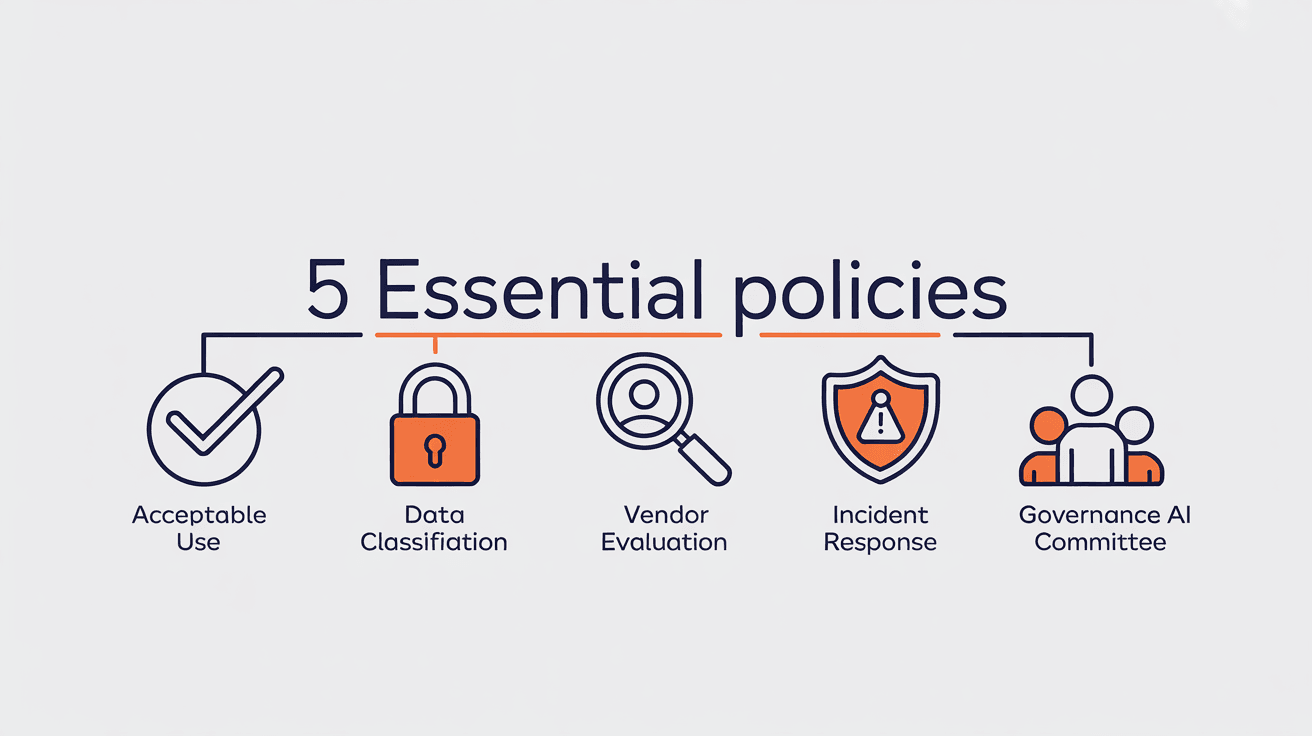
These five policies close that gap. They're not bureaucratic box-checking—they're practical frameworks that protect your organization while enabling productive AI use.
Policy 1: AI Acceptable Use Policy
What it is: The foundational document defining what AI use is permitted, prohibited, and requires approval.
Why you need it: Without clear boundaries, employees default to "if it's not explicitly forbidden, it's allowed." That's how customer data ends up in ChatGPT.
Key Elements
Permitted Uses:
- Approved AI tools and services
- Acceptable use cases (drafting, research, coding assistance)
- Data types that can be used (public, non-sensitive business data)
Prohibited Uses:
- Unapproved AI services
- Processing of sensitive/regulated data (PII, PHI, financial data, trade secrets)
- AI outputs used without human verification
- Automated decisions affecting individuals without oversight
Approval Requirements:
- Process for requesting new AI tools
- Security review requirements
- Ongoing monitoring obligations
Example clause: "Employees may use [approved tool] for drafting and research purposes. Confidential business information, customer data, and regulated information (including PHI, PII, and financial data) may not be entered into any AI system without explicit written approval."
Policy 2: Data Classification Guide
What it is: A framework for categorizing data by sensitivity level and defining what can be used with AI tools.
Why you need it: Employees can't protect data they don't understand. Clear classification enables good decisions at the point of action.
Classification Levels
| Level | Definition | AI Usage |
|---|---|---|
| Public | Intended for public release | Any approved AI tool |
| Internal | Business use only | Approved tools with data controls |
| Confidential | Limited access required | Enterprise AI only, with approval |
| Restricted | Highest sensitivity | No AI usage without explicit approval |
Examples by Type
- Customer data: Confidential (minimum) or Restricted (with PII)
- Financial reports: Confidential
- Trade secrets: Restricted
- Marketing content: Internal
- Public website content: Public
Policy 3: Vendor Evaluation Scorecard
What it is: A standardized process for evaluating AI vendors on security, privacy, and compliance criteria.
Why you need it: New AI tools emerge weekly. Without a consistent evaluation process, shadow AI proliferates.
Essential Evaluation Criteria
Security:
- SOC 2 Type II certification
- Data encryption (in transit and at rest)
- Access controls and audit logging
- Incident response procedures
Privacy:
- Data retention policies
- Model training practices (opt-out available?)
- Data residency options
- Third-party data sharing
Compliance:
- GDPR readiness
- HIPAA capability (if applicable)
- Industry-specific compliance
Operational:
- SLA commitments
- Data export capabilities
- Termination and data deletion procedures
Policy 4: Incident Response Plan
What it is: Procedures for responding to AI-related security incidents, from detection through remediation.
Why you need it: When an AI incident occurs, speed matters. Pre-defined procedures reduce response time and limit damage.
Incident Categories
Category 1: Unauthorized AI Usage
- Employee using unapproved AI tool
- Response: Education, potential discipline, tool blocking
Category 2: Data Exposure (Non-Regulated)
- Business data shared with AI service
- Response: Risk assessment, vendor notification, monitoring
Category 3: Regulated Data Exposure
- PHI, PII, or financial data shared with AI
- Response: Legal notification, regulatory assessment, formal investigation
Category 4: AI Output Failure
- AI-generated content causes harm (false information, legal issues)
- Response: Immediate correction, root cause analysis, process update
Response Framework
- Detection: How incidents are identified and reported
- Triage: Initial assessment and categorization
- Containment: Immediate actions to limit damage
- Investigation: Root cause analysis
- Remediation: Corrective actions
- Documentation: Record keeping for compliance
- Post-mortem: Learning and improvement
Policy 5: Governance Committee Charter
What it is: The structure and authority of your AI governance body.
Why you need it: Someone needs to own AI decisions. A governance committee provides oversight, consistency, and accountability.
Committee Composition
Core members:
- IT Security lead
- Legal/Compliance representative
- Operations representative
- HR representative (for employee-related AI)
Extended members:
- Business unit representatives
- External advisors (as needed)
Committee Responsibilities
- Review and approve AI tools for enterprise use
- Maintain acceptable use policy
- Oversee incident response
- Conduct periodic risk assessments
- Report to executive leadership
Meeting Cadence
- Monthly: Regular policy review and tool approvals
- Quarterly: Risk assessment and policy updates
- As needed: Incident response and urgent matters
Implementation Priority
If you're starting from zero, implement in this order:
- AI Acceptable Use Policy - Creates the foundation
- Data Classification Guide - Enables policy enforcement
- Vendor Evaluation Scorecard - Controls new tool adoption
- Incident Response Plan - Prepares for problems
- Governance Committee Charter - Institutionalizes governance
Each policy builds on the previous, creating a comprehensive governance framework.
Common Implementation Mistakes
Mistake 1: Creating policy without training Policy documents don't change behavior. Training does.
Mistake 2: Making policies too restrictive Overly restrictive policies drive shadow AI. Balance security with productivity.
Mistake 3: Writing and forgetting Policies require regular review and updates as AI evolves.
Mistake 4: No enforcement mechanism Policy without consequences is just a suggestion.
Getting Started
Start small: Begin with an AI Acceptable Use Policy. A simple, clear policy is better than a complex one that never gets implemented.
Train immediately: Policy launch should include training for all employees.
Review regularly: AI evolves fast. Review policies quarterly at minimum.
Next Steps
Get templates: Our Toolkit includes editable templates for all five policies.
Assess first: Take our free AI Risk Assessment to understand your current exposure.
Talk to an expert: Contact us if you need help developing custom policies.